Browse › Tech ›What the hell is that?

What the hell is a Relay

Started by Indecisive · Jun 11, 2004 · 3postsSMF 2010–26vBulletin 2004–05

Indecisivedate not saved · #1

Posted by dewzenol

A relay is used when you have a high power device that you want to turn on when a low power circuit is on. Basically it is a switch; when the low power circuit turns on, an electromagnetic coil in the relay closes (connects) an actual switch that is also inside the relay. That switch will be connected to a high power source like a fat wire straight to the battery.

Here's an example:
On 240, 260, and 280z's a common problem is dim headlights. The culprit is the thin (and often old and corroded) wires that supply power to them. Bottom line is they can't get enough power to be bright. So the solution is to use a relay. Half of the relay (the coil) is wired to the old headlight wire. The other half is wired between a high power wire (straight to the battery) and the headlights. When the headlight switch is turned on, low power is supplied to the coil through the old headlight wires. The electromagnet (coil) closes the switch that connects the headlights to the battery, and we have light!

The simplest relay to wire is an SPST NO (single pole, single throw, normally open). This means there is one switch that the electromagnet controls and it is either on or off. By default it is open (off) but when power is applied to the coil, it closes (turns on) the high power switch.
Such a relay would have four connections. Two would be the coil -- One of these would connect to the old headlight wire in our example, and one would connect to ground (or the chassis.) The other two connections would be the switch -- one would go to the battery (through a fuse) and the other would go to the device you intend to power (the headlights.)

(The opposite of N.O. (normally open) is N.C. (normally closed, or turned on.) If it's not specified, it is 99.999% of the time N.O, meaning that when you apply power it turns the switch on.)

A more complex relay could have multiple poles. This basically means the relay has more than one switch inside. A 3PST NO(3 pole single throw) relay would have three switches inside. It would have two coil connections and SIX switch connections. When you apply power to the coil, all three switches would close.

A more complex relay might also have dual throw instead of single throw. For example, an SPDT relay would have two coil connections and three switch connections. Typically the center switch connection will be where the power comes into the switch. Which of the remaining two connections (let's call them 'A' and 'B') the switch will be set to depends on whether the coil is powered. If the coil is NOT powered, the switch may send power to 'A', and if the coil IS powered, it would send power to 'B'.

This type of relay is useful if, when one circuit is on or off, instead of wanting a device to turn on or off you want to toggle between two devices. A really bad example might be to wire a pressure switch so that when your boost goes past a certain level, it activates an SPDT relay, normally connecting your horn button to your meek Nissan horn, switches to a bank of air horns. Honk the horn when you are picking up the groceries, and you politely warn pedestrians away... but on the highway under boost, EVERYONE KNOWS YOU ARE COMING!
Ok, I warned you it was a bad example, but you get the point.

IndecisiveJun 11, 2004, 3:05 am · #2

[span style=\'color:red\']Posted by dewzenol[/span]

A relay is used when you have a high power device that you want to turn on when a low power circuit is on. Basically it is a switch; when the low power circuit turns on, an electromagnetic coil in the relay closes (connects) an actual switch that is also inside the relay. That switch will be connected to a high power source like a fat wire straight to the battery.

Here\'s an example:
On 240, 260, and 280z\'s a common problem is dim headlights. The culprit is the thin (and often old and corroded) wires that supply power to them. Bottom line is they can\'t get enough power to be bright. So the solution is to use a relay. Half of the relay (the coil) is wired to the old headlight wire. The other half is wired between a high power wire (straight to the battery) and the headlights. When the headlight switch is turned on, low power is supplied to the coil through the old headlight wires. The electromagnet (coil) closes the switch that connects the headlights to the battery, and we have light!

The simplest relay to wire is an SPST NO (single pole, single throw, normally open). This means there is one switch that the electromagnet controls and it is either on or off. By default it is open (off) but when power is applied to the coil, it closes (turns on) the high power switch.
Such a relay would have four connections. Two would be the coil -- One of these would connect to the old headlight wire in our example, and one would connect to ground (or the chassis.) The other two connections would be the switch -- one would go to the battery (through a fuse) and the other would go to the device you intend to power (the headlights.)

(The opposite of N.O. (normally open) is N.C. (normally closed, or turned on.) If it\'s not specified, it is 99.999% of the time N.O, meaning that when you apply power it turns the switch on.)

A more complex relay could have multiple poles. This basically means the relay has more than one switch inside. A 3PST NO(3 pole single throw) relay would have three switches inside. It would have two coil connections and SIX switch connections. When you apply power to the coil, all three switches would close.

A more complex relay might also have dual throw instead of single throw. For example, an SPDT relay would have two coil connections and three switch connections. Typically the center switch connection will be where the power comes into the switch. Which of the remaining two connections (let\'s call them \'A\' and \'B\') the switch will be set to depends on whether the coil is powered. If the coil is NOT powered, the switch may send power to \'A\', and if the coil IS powered, it would send power to \'B\'.

This type of relay is useful if, when one circuit is on or off, instead of wanting a device to turn on or off you want to toggle between two devices. A really bad example might be to wire a pressure switch so that when your boost goes past a certain level, it activates an SPDT relay, normally connecting your horn button to your meek Nissan horn, switches to a bank of air horns. Honk the horn when you are picking up the groceries, and you politely warn pedestrians away... but on the highway under boost, EVERYONE KNOWS YOU ARE COMING!
Ok, I warned you it was a bad example, but you get the point.

IndecisiveJun 11, 2004, 3:14 am · #3

[span style=\'color:red\']Posted by Magnum[/span]

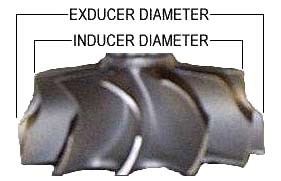
Trim - Trim, simply put, is the size of the turbine and compressor wheels. Sometimes trim is expressed with letters or stage numbers but they actually represent a decimal number that can be calculated with these equations:

compressor trim = (inducer ^2 / exducer^2) x 100

turbine trim = (exducer^2 / inducer^2) x 100

All other things being equal the smaller the trim the less lag there will be, but the turbo may not be able to produce power at higher RPMs. A larger trim will produce more lag but have a lot of top end power.

posted image